Small kitchens get cluttered fast because every inch has to work harder. If your counters always feel crowded, your cabinets are overstuffed, and your kitchen never quite looks clean, the problem usually is not the size of the room. It is the lack of a simple system for how the space is being used.
The Real Reason Small Kitchens Feel So Hard to Keep Organized
A small kitchen does not fall apart because you own too much. Most of the time, it falls apart because too many things are trying to live in the wrong places.
That is what makes small-space kitchen organization so frustrating. You clean the counters, put things away, and within a day or two, the mess is back. The coffee pods drift out. The mail lands by the fruit bowl. The cooking oils stay out because you use them often. The dish soap, sponge, and hand soap start taking over the sink area. None of those things seems like the problem on its own, but together they create visual noise and functional clutter.
The aha moment for most people is this: clutter is often a layout problem before it is a stuff problem.
You do not need a picture-perfect pantry or a full cabinet makeover to fix it. You need your kitchen to support the way you actually cook, unload groceries, make coffee, pack lunches, and clean up at the end of the day.

Problem 1: Your Counters Are Doing Too Many Jobs
One of the biggest mistakes in kitchen organization is treating the countertop like open storage. In a small kitchen, that creates instant clutter because the counter becomes a landing zone for everything.
This happens for a simple reason: counters are easy. Cabinets require opening doors. Drawers fill up. Shelves may be awkward. So the most-used items end up staying out by default.
Here is the problem with that approach: when the counter holds appliances, food, paper clutter, and cleaning supplies all at once, the kitchen feels messy even when it is technically clean.
The fix is to assign your counters a job limit. Not everything that gets used often deserves permanent counter space.
A strong opinion here: most small kitchens should have no more than two daily-use zones visible on the counter. Usually, that means a coffee zone and a cooking zone, or a coffee zone and a prep zone. That is it.
For example, if your counter has a toaster, blender, coffee maker, knife block, paper towels, oils, fruit bowl, and mail tray all out at once, the kitchen will always feel crowded. A better setup is keeping only the coffee maker and a small tray with mugs or pods together in one corner, then using a narrow tray beside the stove for oil, salt, and pepper. The toaster and blender can move into a cabinet or pantry shelf unless they are used every single day.
Trays help because they visually contain the mess. A marble-look tray, wooden riser, or slim handled tray can make a few necessary items feel intentional instead of scattered. That is not just styling. It is a functional organization.
Problem 2: You Are Organizing Cabinets Without Thinking About Reach
A lot of kitchen organization advice focuses on bins, baskets, and matching containers. Those things can help, but they do not solve the deeper issue if the storage layout is wrong.
Most cabinet clutter happens because daily-use items are not stored by frequency. People often place things where they fit, not where they make sense.
That is why you end up crouching to reach mixing bowls, digging past serving platters to grab a skillet, or moving baking dishes every time you want a pot lid. The cabinet is technically organized, but it is annoying to use, so things stop going back where they belong.
The practical fix is to organize by access, not category alone.
Keep your everyday dishes in the easiest-to-reach cabinet. Put weeknight cookware closest to the stove. Store food prep tools near the area where you actually prep food. Use shelf risers inside cabinets to create vertical layers for plates, mugs, or pantry items. Add a pull-out bin or handled basket for snacks, wraps, or baking supplies so you can remove the whole category instead of shuffling things around.
A real-life example: if your lower cabinet holds sheet pans, pots, mixing bowls, and food storage containers all in one stacked pile, you are not disorganized. You just have too many categories fighting for one shelf. Splitting that cabinet with a pan organizer for lids and baking sheets, plus one lidded bin for containers, immediately makes the same cabinet easier to use.
The goal is not just to fit more. The goal is to create less resistance.

Problem 3: Your Sink Area Is Quietly Making the Whole Kitchen Look Messy
People often focus on pantry shelves and cabinets, but in most small kitchens, the sink area is one of the biggest sources of visual clutter.
Why? Because it collects necessary but unattractive things. Dish soap, hand soap, sponges, scrub brushes, stopper plugs, drying mats, stray cups, and whatever was rinsed but not fully put away. Even a pretty kitchen can look messy if the sink zone is chaotic.
The fix is to stop treating the sink edge like overflow space.
Use a compact sink caddy or a divided tray that holds only the tools you use daily. Switch to a matching soap dispenser set if your current bottles are bulky and covered in labels. If you hand-wash often, a foldable dish drying rack or over-the-sink drying mat can help because it can be put away when not needed.
This is also where a counterintuitive insight matters: fewer things visible around the sink can make you more likely to keep it clean. People often assume they need every cleaning tool out for convenience, but visual overload makes the whole area feel harder to reset. Limiting what stays out often improves follow-through.
If your sink corner currently holds a bottle of dish soap, hand soap, sponge, scrub brush, all-purpose spray, a candle, and a wet dish towel draped over the divider, try reducing it to a single tray with soap and one sponge holder. Put the spray under the sink. Hang the towel inside a cabinet door or on a small hook. The space will look calmer immediately.
Problem 4: Food Storage Gets Messy Because Packaging Is Working Against You
One of the most overlooked causes of kitchen clutter is food packaging. Bags slump. Boxes leave gaps. Individually wrapped snacks scatter. Opened items get shoved back onto shelves and disappear behind larger containers.
This is why pantries and snack cabinets look messy so quickly, especially in small kitchens.
The solution is not decanting everything into matching jars. That can look nice, but it is often too much work for real life. The smarter fix is selective containment.
Use clear bins for categories that tend to spread, like snacks, breakfast items, baking ingredients, or packet mixes. Transfer only the items that truly benefit from containers, like flour, sugar, cereal, pasta, or frequently used grains. Turntables work especially well for oils, sauces, vinegars, and condiments in deeper shelves because they bring items to you instead of creating a hidden back row.
This is where budget-friendly kitchen organization matters. You do not need an expensive pantry edit. A few clear bins, a lazy Susan, and a set of stackable containers for the messiest staples will do more than a dozen decorative baskets.
For example, if your pantry shelf has granola bars, crackers, peanut butter, pasta boxes, and tea all mixed, the problem is not that you need prettier labels. The problem is that there is no category control. One bin for snacks, one for breakfast, and one turntable for jars and bottles creates order with very little effort.

Problem 5: You Keep Buying Organizers Before Fixing the Flow
This is one of the most common small-space mistakes, and it is worth saying clearly: organizers do not create systems. They support systems.
That means buying containers before deciding how your kitchen should function often leads to more clutter, not less. You end up with bins that do not fit, drawer dividers that waste space, and pretty baskets holding random things with no real purpose.
The better approach is to watch your kitchen for friction points first.
Where do things pile up? What gets left out every day? Which drawer is annoying to open? Which cabinet makes you shift three things to grab one? Those are the places that need solutions.
Then choose products that solve specific problems. A narrow rolling cart might help if you truly have a dead gap beside the fridge. Drawer dividers make sense if utensils and tools are constantly mixing. A two-tier under-sink organizer works if that cabinet is deep and messy. But those products only help when they match an actual need.
A strong stance: decorative organization without functional editing is a waste of money.
If the goal is a kitchen that feels easier to use, every organizer should earn its place.
Problem 6: You Have No Reset Routine, So Clutter Always Returns
Even the most organized kitchen will slide backward without a reset habit. In a small space, that happens quickly because there is very little room for overflow.
This is where many people get stuck. They do a deep clean, buy some organizers, maybe even restyle the counters, but they never create a maintenance rhythm. So the kitchen slowly fills back up.
The fix is to create a simple kitchen reset that takes ten minutes or less and can be done at the end of the day.
A Simple Kitchen Reset System for Small Spaces
Step 1: Clear the counters completely.
Move everything off the surface except the items that truly belong in your two designated daily-use zones.
Step 2: Group by function.
Make quick categories: coffee, cooking, cleaning, snacks, papers, storage containers, and random items.
Step 3: Remove what does not belong in the kitchen.
Mail, receipts, batteries, tools, kids’ papers, and unrelated extras should leave the room immediately.
Step 4: Rebuild only the visible zones you actually use.
Set up your coffee corner on one tray. Set up your cooking essentials on another tray or small riser near the stove.
Step 5: Fix one cabinet and one drawer.
Do not try to organize the whole kitchen in one day. Choose the worst drawer and the most frustrating cabinet first.
Step 6: Add containment where the clutter repeats.
Use one or two bins, a turntable, a shelf riser, or a drawer divider only after you see where categories keep collapsing.
Step 7: Do a nightly three-minute reset.
Put away dishes, clear paper clutter, return items to trays or bins, wipe counters, and reset the sink.
That last step matters most. The kitchen does not stay organized because it is perfect. It stays organized because it is easy to reset.
What a Functional Small Kitchen Actually Looks Like
A well-organized small kitchen is not empty. It’s edited.
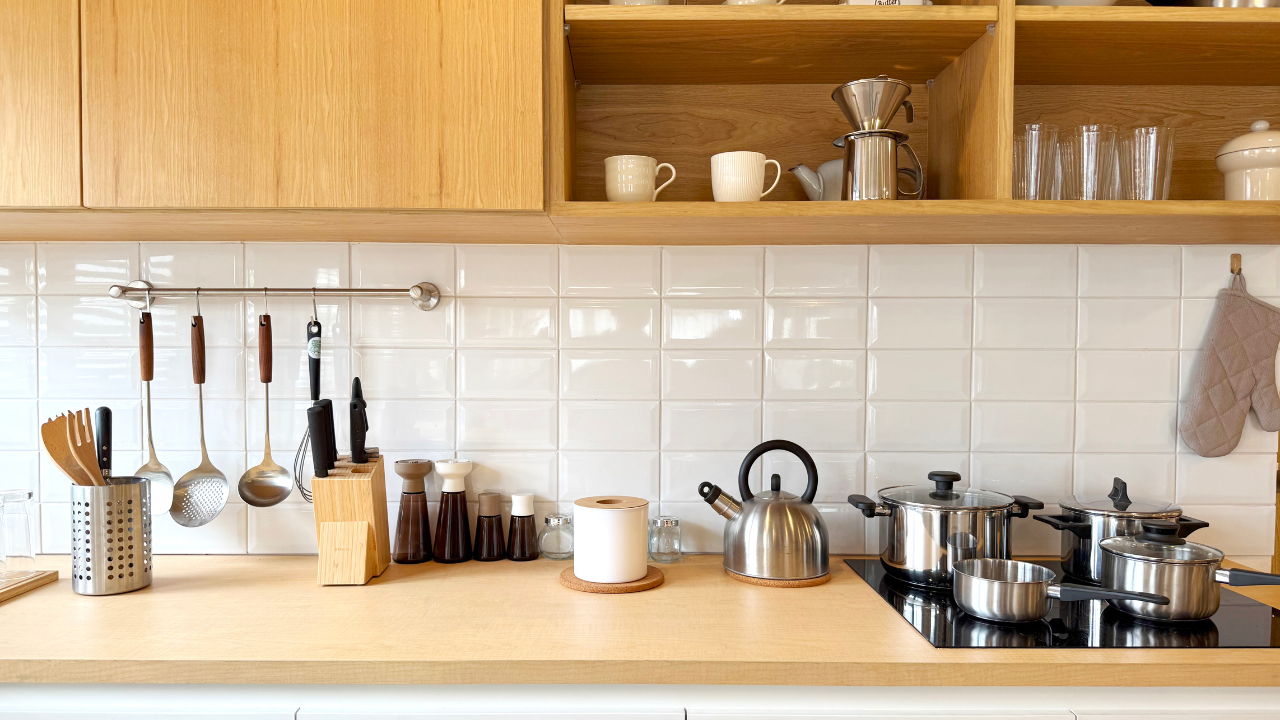
It might still have a coffee maker on the counter. It may still have a wooden utensil crock by the stove. Or it might even have a tray with oils and salt out in the open. The difference is that each visible item has a reason to be there.
If your kitchen works hard every day, it does not need to look like a showroom. It needs to support real life.
That means your blender can live in a cabinet if it is only used twice a week. Your snack bin should be easy for kids to reach if that makes mornings smoother. Your prettiest canisters should not take priority over the storage setup that actually helps you cook dinner without frustration.
Function first. Style second. That is what makes a kitchen feel calm.
A small kitchen does not need more space to feel better. It needs clearer decisions about what stays out, what gets stored, and what actually earns room in your daily routine.
This post may contain affiliate links. If you purchase through these links, I may earn a small commission at no additional cost to you.